Currently Empty: 0,00€
Circular Forest: New Milestone in Low-Power Fire Detection
laila
- 28 de October de 2026
- 0 Comments
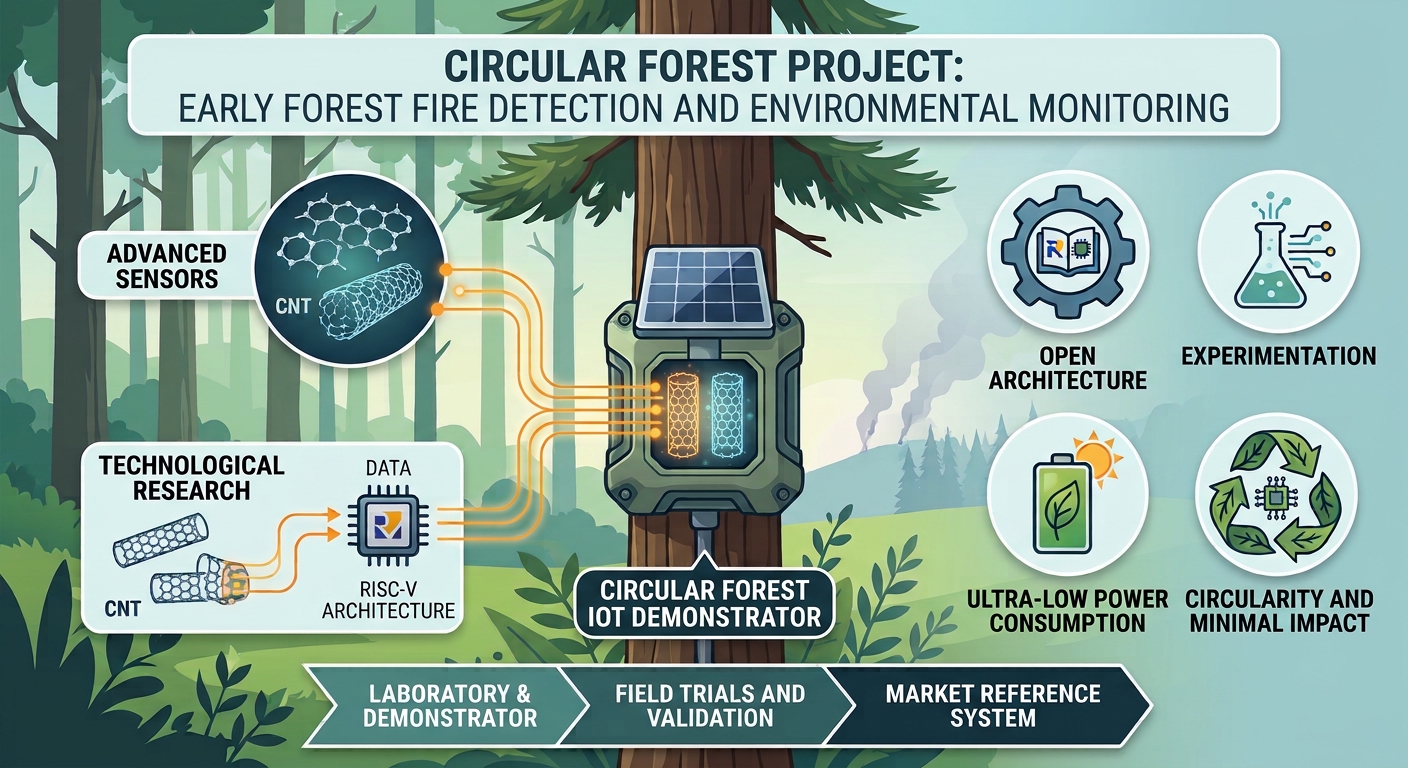
The Circular Forest project advances research into low-power sensing technologies for early forest fire detection and environmental monitoring.
LINZA ASIP Digital has presented the main findings of the Circular Forest project during its Technical Audit, outlining the progress made in the research and the development pathways identified for the next phases.
Circular Forest investigates how advanced sensors, data processing and low-power communications can be combined to develop solutions for early forest fire detection, with a particular focus on energy efficiency, operational autonomy and sustainability.
Research into Sensing Technologies and IoT Architecture
The Circular Forest project investigates the capabilities and limitations of different sensing technologies for early forest fire detection and environmental monitoring. The team analyses these technologies and defines specific experimental pathways involving carbon nanotubes (CNTs) and graphene-based electrochemical sensors. This work guides the selection of a sensor combination and an architecture that the team integrates and optimises through a fully customised IoT demonstrator.
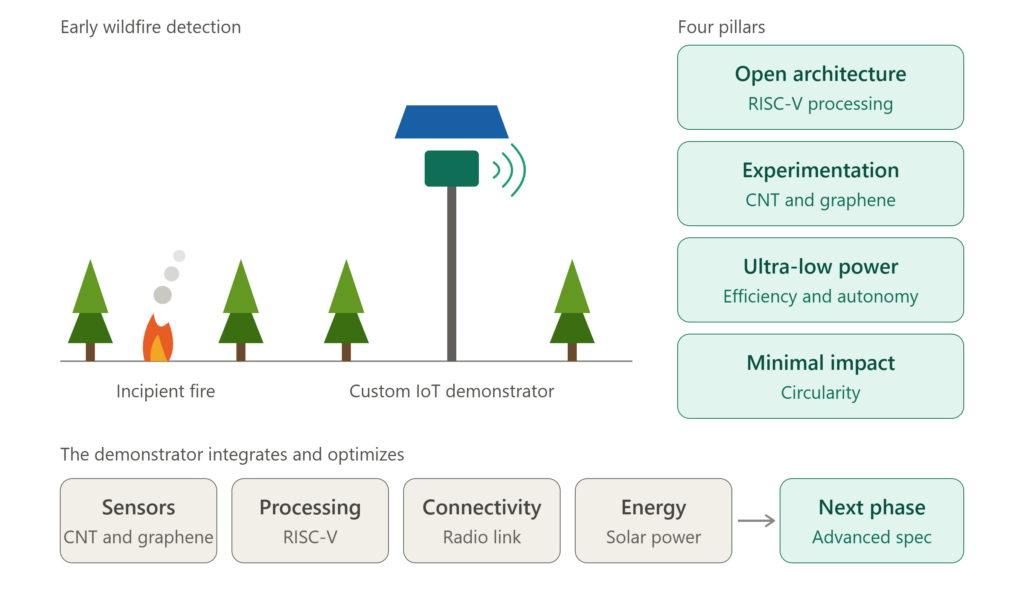
The research is built around four key pillars: open architecture, including RISC-V processing; technological experimentation; ultra-low power consumption; and minimal environmental impact and circularity.
A Demonstrator for Technology Integration and Validation
The IoT demonstrator enables the team to study in the laboratory how sensors, data processing, communications and solar power supply interact. The team is investigating how to combine minimal power consumption, energy efficiency and operational autonomy with a lightweight, compact enclosure, reasonable cost and minimal environmental impact.
This work makes it possible to evaluate design and integration decisions before moving into further development stages, taking into account both technical requirements and the operating conditions that a solution intended for forest environments will need to withstand.
An Advanced Specification for the Next Development Phase
The insights gained have enabled the team to define an advanced specification for a subsequent phase, which could lead to the development of a benchmark system in the forest fire early detection market. This specification incorporates improvements to the sensors, their programming, communications, power supply and physical integration, together with the field trials required to validate system performance.
The findings presented at the Technical Audit represent an important step in the evolution of Circular Forest, moving from research and experimentation with sensing technologies towards the definition of an integrated architecture that can progress to future testing under real-world conditions.
Circular Forest continues to explore the application of semiconductors, advanced sensing and IoT to environmental monitoring, with the aim of contributing to the development of technological solutions for forest fire prevention and early detection.
Circular Forest is part of the PERTE Chip initiative
Spain’s strategic programme to strengthen the country’s semiconductor industry and technological capabilities. The project contributes to the development of advanced sensing technologies and semiconductor-based solutions for environmental monitoring and forest fire prevention.

More Information
For further information about the Circular Forest project, please contact Laila Quiles Blanco, Marketing Director at LINZA ASIP Digital lquiles@alphasip.es